table of contents
- Heading 1
- Heading 1
- Heading 1
share this
The Texas Data Center Buildout: What the Electrical Scope Actually Includes
Texas has become one of the most active data center markets in the country, and the electrical scope on these projects is consistently underestimated by people who have not built one.
It is not a large commercial building with more panels. It is a power delivery project with a building around it.
Here is what the electrical scope actually covers, roughly in the order it gets built.
Utility Interconnection and Substation Work
Before anything inside the building matters, power has to arrive. Depending on the site and the load, that can mean a dedicated substation, a utility tie, or a customer owned substation built to the utility’s standards.
This is where schedules live or die. Interconnection timelines, utility review cycles, and long lead transformer procurement all sit upstream of every other electrical activity, and none of them move faster because the project is behind.
Scope typically includes grounding grid, conduit and duct bank, control building wiring, relay and protection wiring, and support through energization.
Medium Voltage Distribution
From the point of service, power gets distributed at medium voltage across the campus to unit substations or transformers serving each block of load.
Scope includes medium voltage cable pulls, splices, and terminations, along with switchgear setting and connection. Terminations at this voltage class are where installation quality shows up, and where failures originate when the work is rushed.
Low Voltage Distribution and Critical Power
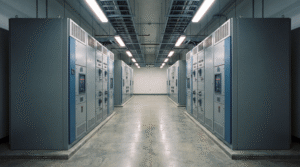
Downstream of the transformers, the critical power chain runs through switchboards, UPS systems, power distribution units, and remote power panels out to the white space.
This is where the redundancy architecture becomes physical. An N+1 or 2N design is not a diagram, it is a specific set of feeders, tie breakers, and distribution paths that have to be installed exactly as engineered for the redundancy to actually exist under fault.
Standby and Emergency Power
Generator paralleling switchgear, generator feeders, fuel system electrical, and automatic transfer equipment. Plus the controls that make the transfer happen correctly under load, which is a very different thing from making it happen during a demo.
Grounding and Bonding
Data centers are more sensitive to grounding quality than almost any other facility type. Scope covers the ground grid, building steel bonding, equipment grounding throughout the distribution system, and signal reference grounding in the white space.
Grounding is cheap to install correctly and extraordinarily expensive to correct after equipment is energized and racked.
Below Grade Conduit and Duct Bank
Feeder routing between the substation, the generator yard, and the building typically runs underground. Duct bank construction, conduit spacing, concrete encasement, manholes, and pull boxes all fall here.
Spacing and encasement matter beyond code compliance, because conductor heat dissipation in a duct bank affects ampacity, and a duct bank built tighter than designed can quietly derate the feeders it carries.
Controls, Monitoring, and Instrumentation
Power monitoring, building management system integration, breaker status and metering, and the instrumentation wiring that ties electrical equipment into the systems operators actually watch.
This scope is often the last to be fully defined and the first to get compressed, which is why it is a common source of late change orders.
Lighting, General Power, and Fire Alarm Interface
Interior and exterior lighting, general receptacle power, mechanical equipment connections, and coordination with fire alarm and life safety systems. Lower complexity, meaningful volume, and it still has to be complete for occupancy.
Commissioning Support
Level 4 and Level 5 commissioning drive electrical crews back into the building repeatedly. Point to point checks, breaker coordination verification, load bank testing support, failure mode testing, and punch resolution.
Contractors who plan for this staff it. Contractors who do not treat it as an overrun.
What Owners Consistently Underestimate
- Long lead equipment. Switchgear and transformer lead times drive the schedule more than labor availability does
- Utility timeline. Interconnection is outside your contractor’s control and rarely accelerates
- Skilled labor availability. Texas is building a lot simultaneously, and qualified medium voltage crews are the constraint
- Commissioning duration. The electrical scope is not finished when installation is finished
- Documentation load. Mission critical turnover packages are substantially heavier than commercial ones
Working With Cava Electric
We work across the full scope above, from substation grounding grid through white space distribution, on projects in the Texas market. Our crews are prequalified, our supervisors hold OSHA 30, and our safe work practices follow NFPA 70E.
Planning a data center project in Texas? Send us the drawings, and we will walk you through our approach. Contact Us Here